Atmospheric conditions
Type of resources
Available actions
IADC Research Activities
Topics
Keywords
Contact for the resource
Provided by
Years
Formats
Representation types
Update frequencies
status
Scale
-

RIS: 3471 ARCA aims to develop a conceptual model on the mechanism(s) behind the release of large volumes of cold and fresh water from melting of ice caps, investigating this complex system from both paleoclimatic and modern air-sea-ice interaction process point of view. ARCA fits well within the Italian Strategy for Arctic. Testing and calibration of sensors measurement of vertical profile of turbulence, meteorological paramaters and characterisitic of the snow surface.
-
Isotopic characterisation of arcic ponds Sampling of ponds and surrouding terrestrial envionrment. matter (expressed as ash fry dry matter) and N content as a percentage in soil and lake sediment.
-

Homogenized Tethered Balloon record at station Ny-Ålesund, Spitsbergen in 2018 The scientific goals of BC-3D are to evaluate the distribution of Black Carbon and Mineral Dust in the first layers of atmosphere and surface snow over targeted Svalbard glaciers in order to identify the mechanisms of the air/snow exchanges also assisted by model predictions to provide the full 3D picture. Aerosol vertical profiles by tethered balloon: Aerosol vertical profiles gridded at a 50 m spatial resolution: R, T, P, RH, Aerosol size distribution, BC concentration. Maximum altitudes 1500 m.
-
Ice Nuclei Particle Concentration (INPAIR) INPAIR Svalbard' Chemistry and Physics of the Atmosphere: Ice nucleating particle (INPs) concentration obtained in spring and summer campaigns in the Arctic Region. Measurements of INPs concentrations and activation fraction of aerosol in Arctic (e.g. Gruvebadet observatory in Ny-Ãlesund). b) Correlating INPs concentration with meteorological parameters and physicochemical characterisations. Instrument: PM1 and PM10 sampling lines. DFPC chamber
-
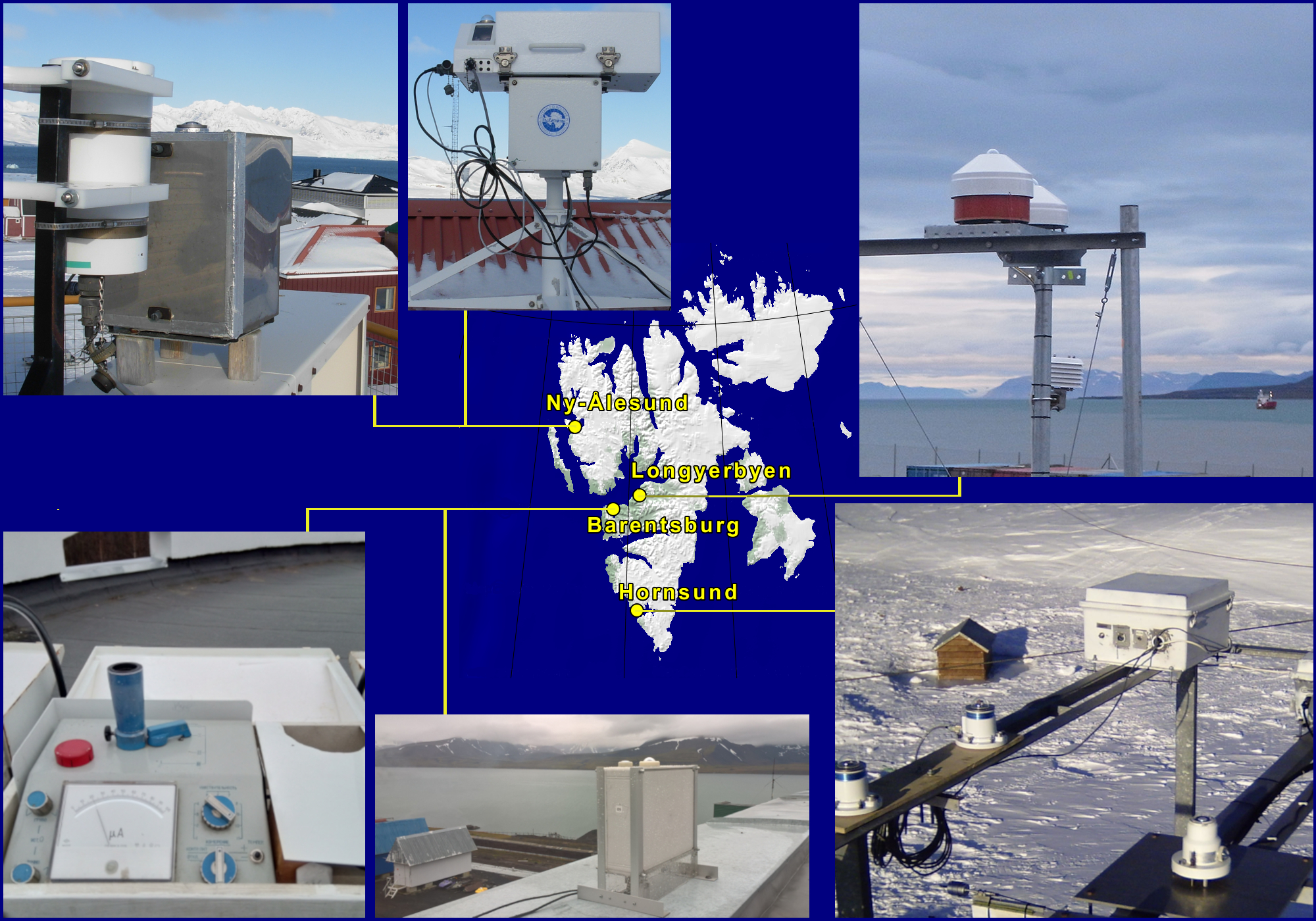
Ultraviolet Irradiance Variability in the Arctic U-VIVA Dataset contains results of the observed at 4 Svalbard stations ozone depletion episode that took place in the spring 2020 and its effect on the ultraviolet solar radiation reaching the ground. The ozone column was registered by Brewer #050 spectroradiometer, GUV and UV-RAD filter radiometers all operating in Ny-Ålesund, and by M-124 ozonometer working in Barentsburg. The solar radiation in UV-B, UV-A and erythemal UVE spectral bands that are impacted by the ozone column was measured by GUV and UV-RAD radiometers at Ny-Ålesund and, by UVS-E-T and UVS-AE-T Kipp & Zonen radiometers operating in Longyearbyen and Hornsund, respectively. An analysis of the data is presented in the 2021 SESS report published by Svalbard Integrated Arctic Earth Observing System (SIOS).
-

Atmospheric Gondola for Aerosol Profiles (AGAP) The scientific goals of AGAP are to develop novel aerosol payloads and evaluate the vertical distribution of aerosol properties in the Arctic Boundary Layer. Dataset consists in Aerosol vertical profiles gridded at a 50 m spatial resolution: R, T, P, RH, Aerosol size distribution, BC concentration, O3. Maximum altitudes 1500 m.
-

Atmospheric Gondola for Aerosol Profiles (AGAP) The scientific goals of AGAP are to develop novel aerosol payloads and evaluate the vertical distribution of aerosol properties in the Arctic Boundary Layer. Dataset consists in Aerosol vertical profiles gridded at a 50 m spatial resolution: R, T, P, RH, Aerosol size distribution, BC concentration, O3. Maximum altitudes 1500 m.
-

Atmospheric Gondola for Aerosol Profiles (AGAP) The scientific goals of AGAP are to develop novel aerosol payloads and evaluate the vertical distribution of aerosol properties in the Arctic Boundary Layer. Dataset consists in Aerosol vertical profiles gridded at a 50 m spatial resolution: R, T, P, RH, Aerosol size distribution, BC concentration, O3. Maximum altitudes 1500 m.
-
Ice Nuclei Particle Concentration (INP) Ice nucleating particle (INPs) concentration obtained in spring and summer campaigns in the Arctic Region. Sampling lines allow the aerosol particles collection onto the filters and the sampling line for the continuos measurements of size distribution with the OPC and SMPS. The aim is to improve our understanding of aerosol-cloud-climate interactions and representation of climate models.
-

Atmospheric Gondola for Aerosol Profiles (AGAP) Developing novel aerosol payloads and evaluate the vertical distribution of aerosol properties in the Arctic Boundary Layer. Aerosol vertical profiles by tethered balloon: Aerosol vertical profiles gridded at a 50 m spatial resolution: R, T, P, RH, Aerosol size distribution, BC concentration, O3. Maximum altitudes 1500 m.