ATMOSPHERE
Type of resources
Available actions
IADC Research Activities
Topics
Keywords
Contact for the resource
Provided by
Years
Formats
Representation types
Update frequencies
status
Scale
-

Concentration data for Sulfuric Acid (SA), Methane Sulfonic Acid (MSA) and Iodic Acid (IA) - in molecule per cubic centimeter (#.cm-3). Averaging time 60 min.
-
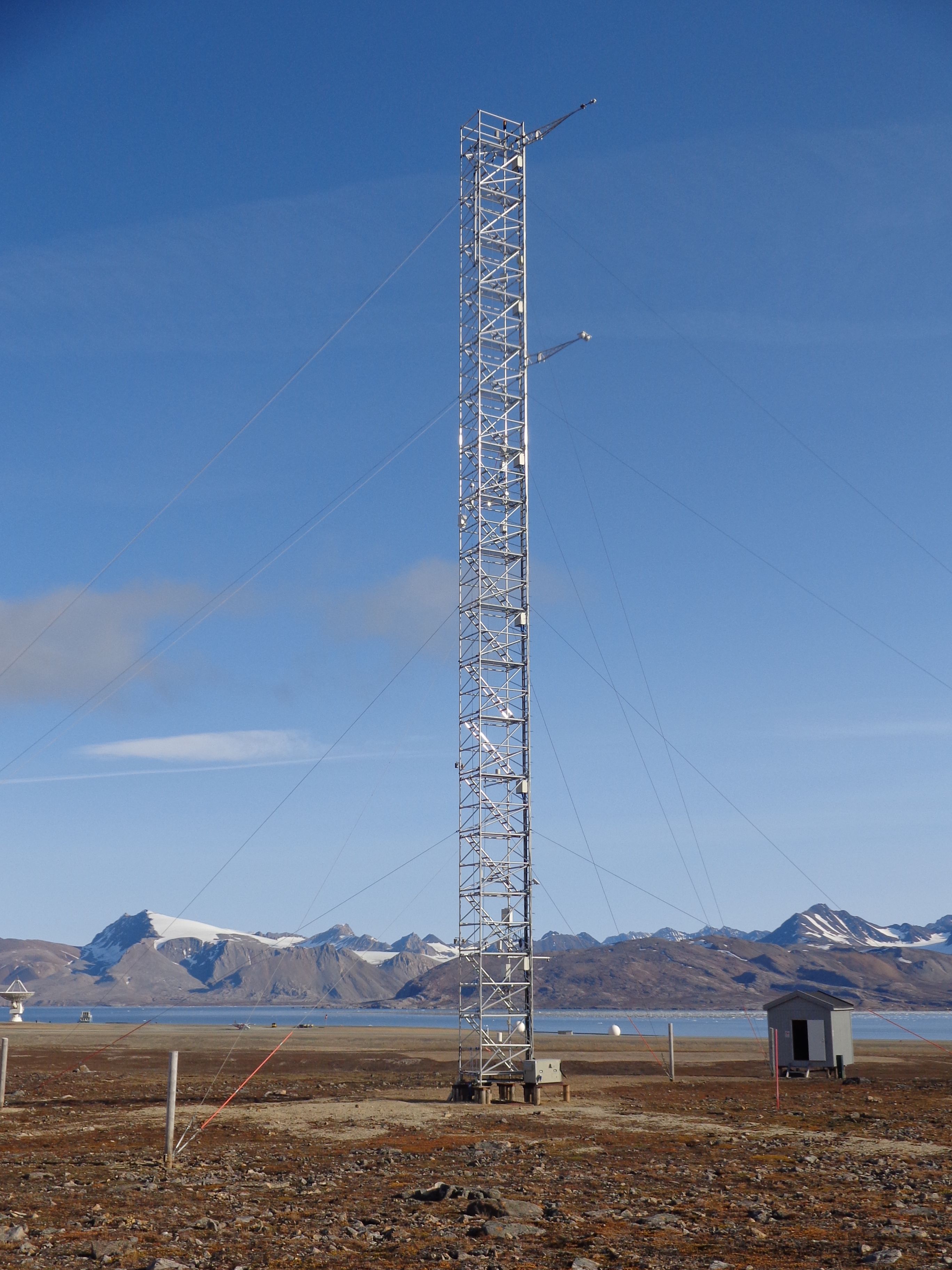
The Climate Change Tower Integrated Project (CCT-IP) represents the guide lines of the italian research in the arctic and aims to study the interaction between all the components of the climate system in the Arctic. The Amundsen-Nobile Climate Change Tower (CCT) is the key infrastructure of the project, and provides continuous acquisition of the atmospheric parameters at different heights as well as at the interface between the surface and the atmosphere. The sensor used to measure the radiation budget and energy fluxes is a CNR1 net radiometer at 33 m of height and a CM11 and a CG4 at 25 m to measure the upwelling radiation from the surface. 30 minutes average (μ) and standard deviation (σ) of radiation data as well as products such as total net radiation average and shortwave albedo are available for the download. Data at resolution of 1 minute are available for online visualization and downloadable under request. Partly funded by Arctic PASSION project (agreement number 101003472).
-

The Climate Change Tower Integrated Project (CCT-IP) reflects the priorities of Italian Arctic research and aims to investigate the interactions among all components of the Arctic climate system. The Amundsen-Nobile Climate Change Tower (CCT) serves as the project’s central infrastructure, providing continuous measurements of atmospheric parameters at multiple heights and at the critical interface between the surface and the atmosphere. A SPN1 net radiometer, installed at a height of 33 m in 2023, is used to measure the radiation partition between incoming direct and diffuse irradiance. Previously, in 2009, a combination of sensors—including a CNR1 net radiometer at 33 m and CM11 and CG4 sensors at 25 m—was deployed for the same purpose. Radiation data are processed to provide 30-minute averages (μ) and standard deviations (σ), along with derived products such as total net radiation and an indication of sun presence. These data will be available for download. Additionally, 1-minute resolution data are available for download upon request.
-

Ionospheric Scintillations Arctic Campaign Coordinated Observations (ISACCO) The aim of ISACCO is to perform a scintillation measurements campaign by a GNSS Ionospheric Scintillation and TEC Monito) at Ny-Ålesund and Longyearbyen (Svalbard, Norway). The System consists of dual-frequency receiver with special firmware specifically configured to measure amplitude and phase scintillation. Starting from the end of 2015 a Septentrio PolaRxS_PRO receiver has been installed in one of the two observation sites in Svalbard, NyÅlesund, for the observation of all the available satellite constellations GALILEO, GPS, GLONASS at the Svalbard longitude.
-
The Climate Change Tower Integrated Project (CCT-IP) represents the guide lines of the italian research in the arctic and aims to study the interaction between all the components of the climate system in the Arctic. The Amundsen-Nobile Climate Change Tower (CCT) is the key infrastructure of the project, and provides continuous acquisition of the atmospheric parameters at different heights as well as at the interface between the surface and the atmosphere. Images of the sky are taken every 15 minutes and are available under request.
-
Ionospheric Scintillations Arctic Campaign Coordinated Observations (ISACCO) The aim of ISACCO is to perform a scintillation measurements campaign by a GNSS Ionospheric Scintillation and TEC Monito) at Ny-Ålesund and Longyearbyen (Svalbard, Norway). The System consists of dual-frequency receiver with special firmware specifically configured to measure amplitude and phase scintillation. Starting from the end of 2015 a Septentrio PolaRxS_PRO receiver has been installed in one of the two observation sites in Svalbard, NyÅlesund, for the observation of all the available satellite constellations GALILEO, GPS, GLONASS at the Svalbard longitude.
-

Measurements are obtained using a Pyrgeometer Kipp&Zonen, model CGR4, installed at Thule Air Base (220 m a.s.l.) in May 2013. The instrument sensitivity was determined during factory calibration for temperatures down to -40 °C, thus specifically suited for the polar environment. Data are acquired by a datalogger at 30 s time intervals and then transferred to a PC. The CGR4 and its dedicated PC are maintained by Daniela Meloni at ENEA.
-
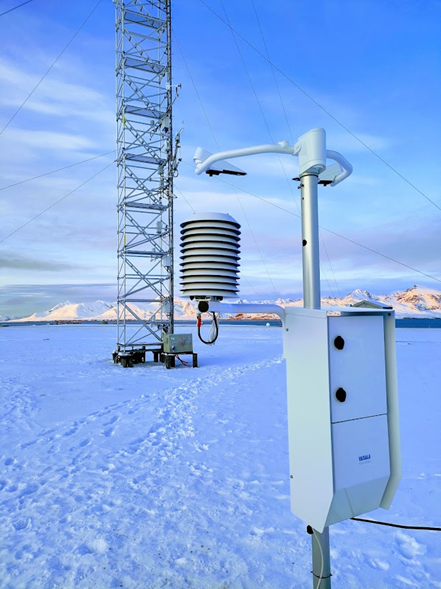
The Climate Change Tower Integrated Project (CCT-IP) represents the guide lines of the italian research in the arctic and aims to study the interaction between all the components of the climate system in the Arctic. The Amundsen-Nobile Climate Change Tower (CCT) is the key infrastructure of the project, and provides continuous acquisition of the atmospheric parameters at different heights as well as at the interface between the surface and the atmosphere. Precipitation data (liquid and solid) are obtained from an optical disdrometer (Vaisala FD70). Partly funded by Arctic PASSION project (agreement number 101003472). Data are available under request.
-
Measurement of the concentration and turbulent flux of CO2 and CH4 at 15 m above sea level on the CCT.
-

The PAGINA (Pan-Arctic GNSS Infrastructure for Atmospheric Science) project addresses the current gap in GNSS observations across the Arctic by developing a unified IT platform for the management and sharing of data acquired through a distributed network of high-rate ground-based GNSS receivers. The project integrates observations collected at sites in Svalbard, Finland, Greenland, and Canada, building on existing Arctic monitoring networks operated by INGV (Istituto Nazionale di Geofisica e Vulcanologia, Italy), UNB (University of New Brunswick, Canada), and FMI (Finnish Meteorological Institute, Finland). The primary objective of PAGINA is to provide a single access point to data from at least 20 stations equipped with high-rate GNSS Ionospheric Scintillation Monitoring Receivers (ISMRs). This infrastructure is designed to support scientific investigations of the polar upper atmosphere, with a particular focus on ionospheric irregularities and space weather-related phenomena.